
I’m playing Alec Guinness — this is how I did it and what his son told me
Zeb Soanes admired the Oscar-winning actor so much he sent him a letter. He reveals how he transformed into the actor for a one-man play Two Halves of Guinness
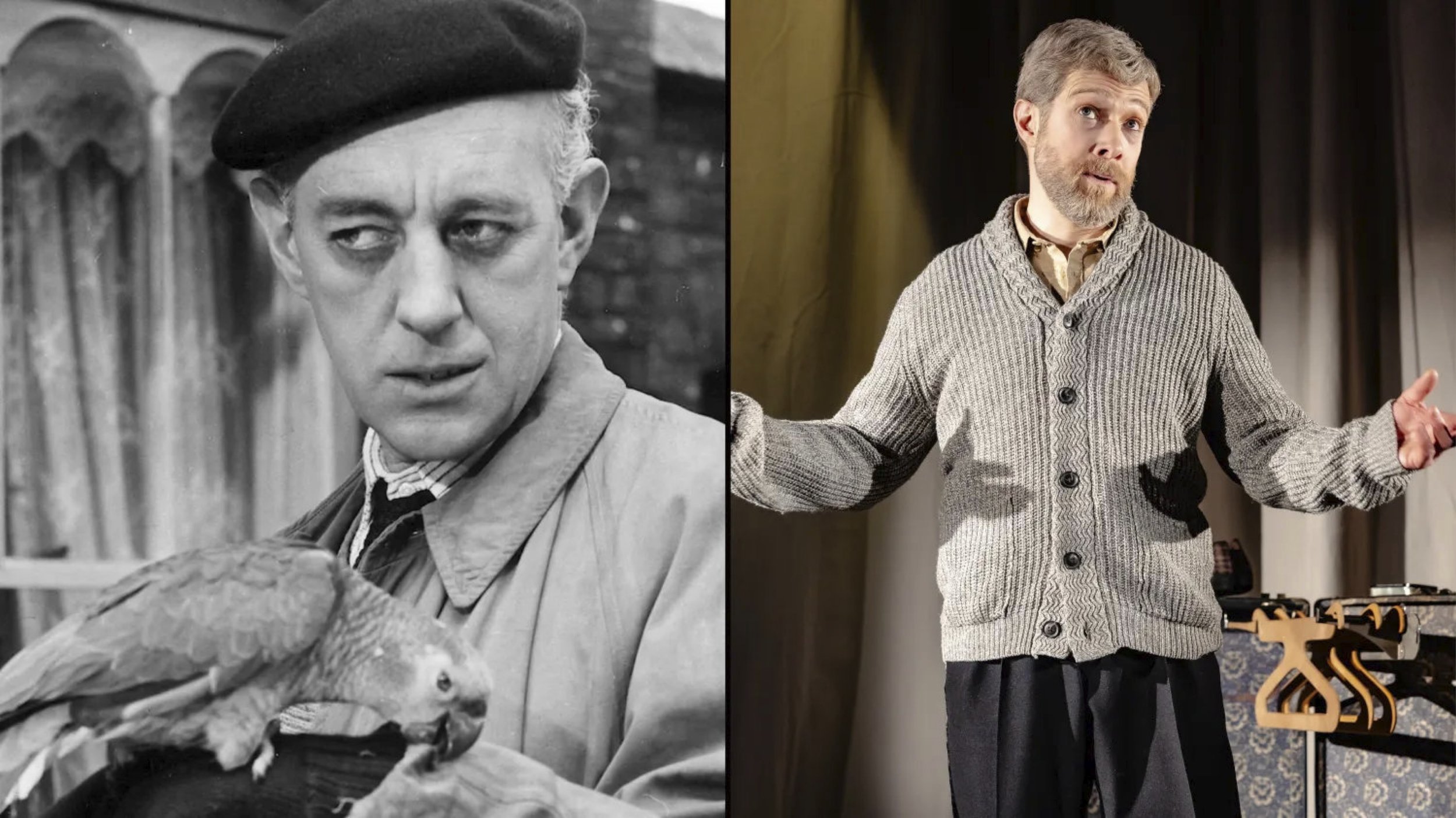
Alec Guinness in Zeb Soanes’s favourite film, The Ladykillers, and Soanes in Two Halves of Guinness
At 17, with hopes of becoming an actor, I summoned the courage to write to Alec Guinness. I’d long been drawn to him — there was something in the contradiction of a shy man who set out to be a performer that I recognised in myself. I’d read he didn’t respond to anything relating to Star Wars and his performance as Obi-Wan Kenobi, so I was careful to note the qualities I admired in his other work. I never dared hope for a reply, but five days later when I arrived home from school, a small correspondence card was propped on the kitchen table, neatly addressed to “Mr Zeb Soanes”, wishing me luck with my career. My hero knew my name. That card went straight into a clip frame from a pound shop in Lowestoft High Street —and now accompanies me on tour in my dressing rooms, the last thing I see before I step on stage to portray him in Two Halves of Guinness, a one-man play about the double Oscar winner’s life.
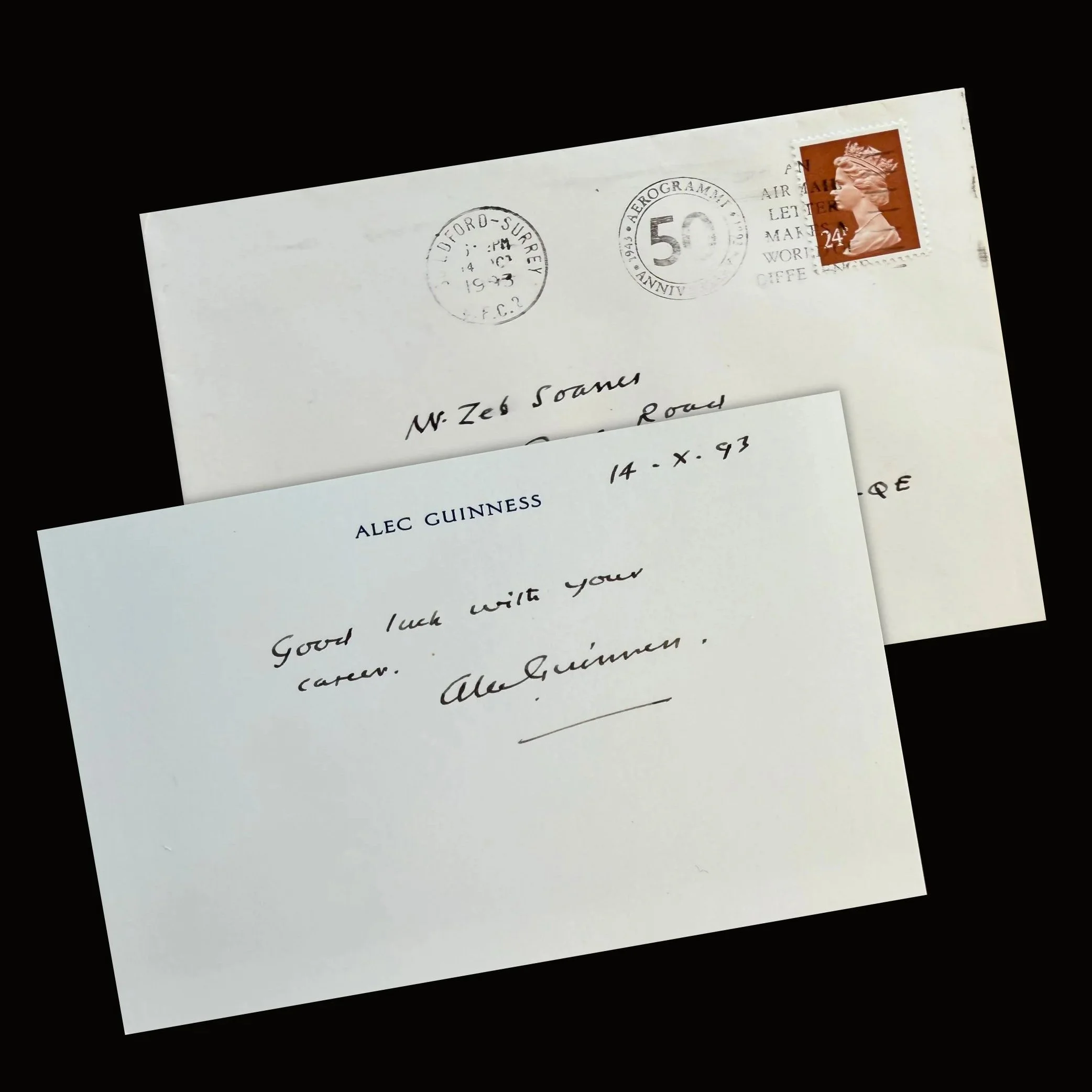
The handwritten card Soanes received from his hero
My admiration for him started long before that letter. My father always encouraged me to watch old British comedy films —starring Margaret Rutherford, Alastair Sim, Dennis Price, Peter Sellers and Guinness. Those classic films, from Kind Hearts and Coronets to The Importance of Being Earnest, shaped my personality, my character and my sense of humour. I was a very shy young man, yet found confidence in playing other people. I was always putting on puppet shows, inventing characters, doing voices, and I discovered there was nothing more rewarding and addictive than winning the attention of the adults around me and pulling them into my imaginative world.
It was Guinness’s own enigmatic quality that drew me in. I found other actors such as Laurence Olivier and John Gielgud were very “outward” performers. It felt as if Guinness had identified the little game or secret at the core of whichever part he was playing and, almost like a conjuror, invited you in to join him. It was this mischievousness that I found compelling. Like his deliciously arch role in the 1955 Ealing comedy The Ladykillers, still my favourite film. As the mastermind of the most incompetent heist gang, Guinness leads an impeccable ensemble that includes Cecil Parker, Herbert Lom and Sellers in his first significant film role.
I was an old soul. My father is a Methodist minister, and we grew up in a church environment where my sisters and I were encouraged to form friendships with much older people such as “The Smith Ladies”, two spinster sisters who, just like Mrs Wilberforce in The Ladykillers, would often invite us to tea on Sunday afternoons. I never viewed the older generation as another species; I just saw people who had had a headstart on me in life. It wasn’t age that mattered, it was character.
Guinness was born in Maida Vale, never knowing who his father was. He started working in theatre when he was 20 and found film success in the Ealing comedies, winning his first Oscar for The Bridge on the River Kwai. He moved seamlessly between stage and screen, equally adept at both; from Shakespearean roles such as Hamlet to the cinematic epics of David Lean. He was a man of immense skill but also full of contradictions: a private man, a perfectionist, sometimes prickly, always attentive to detail.
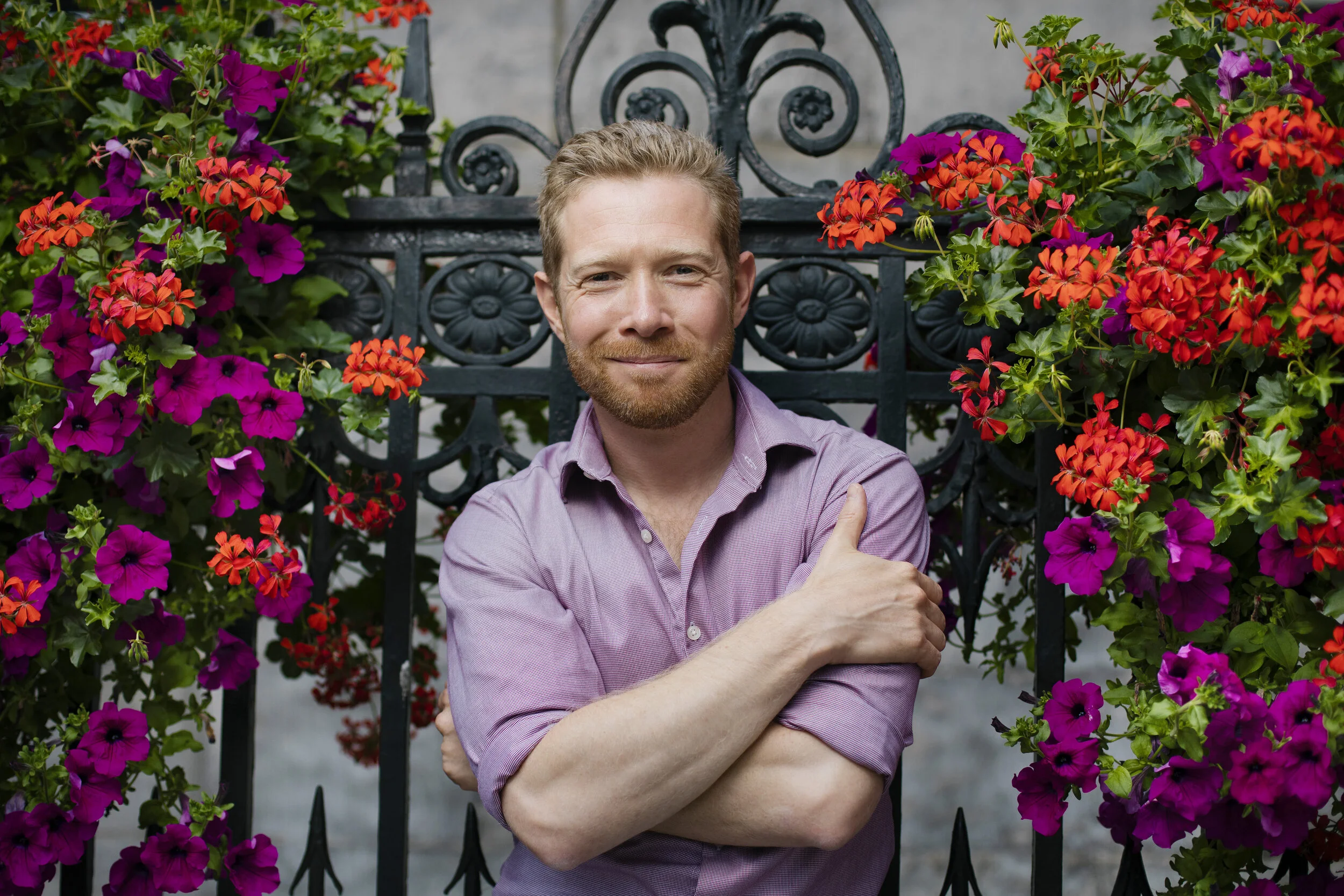
Zeb Soanes: “It was Alec Guinness’s own enigmatic quality that drew me in. It felt as if he had identified the little game or secret at the core of whichever part he was playing”
The title of this play, Two Halves of Guinness, hints at those contrasts: the stage and the screen; the public and private —including the grey area of his sexuality. His contemporary Sam Beazley, with whom he lodged when they were young actors, believed it was this ambiguity that made Guinness such a protean actor. But at the heart of the play is a gnawing sense of nothingness, an identity vacuum. His mother took his father’s name (if indeed she knew it) to the grave, so Guinness didn’t know where he was from. It is suggested that a casual liaison with one of the Guinness brewing family may have occurred when his mother was working as a barmaid at the 1913 Cowes Regatta. Decades later the Guinnesses approached Alec, noting a family likeness —but had no proof that he was a relative. What fascinates me in Two Halves of Guinness is how he clothes the nothingness with the many masks of Alec Guinness, with all the extraordinary performances he gave.
The play starts with him receiving his lifetime achievement Oscar in 1980, and lamenting that he will only be remembered for Star Wars, a role he described as “fairytale rubbish” (yet for which he shrewdly negotiated 2.25 per cent of the royalties). Guinness then leads the audience through his career, ending with his role in Tinker Tailor Soldier Spy, where, as George Smiley, he makes peace with the nothingness. He realises that he doesn’t need false noses or an elaborate disguise, being “nobody” is his unique quality.
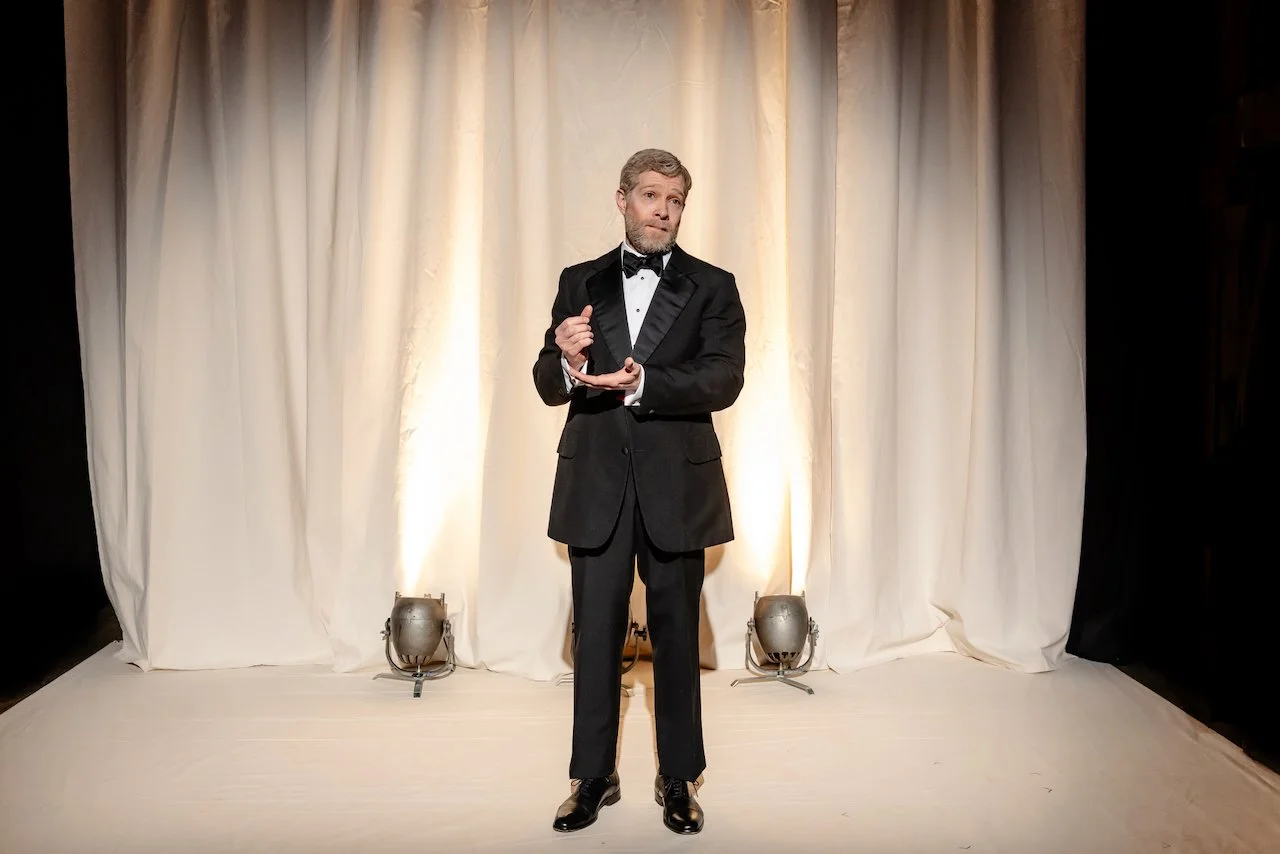
Soanes: “Preparing to play Guinness has been an intense process: rereading biographies, revisiting films and speaking with people who knew him”
I’ve lived with Guinness, as a fan, for nearly 40 years, but preparing to play him has been an intense process: rereading biographies, revisiting films and speaking with people who knew him. Eileen Atkins was invaluable in explaining how thin-skinned and sensitive he could be, and Siân Phillips helped me to understand his stage physicality — how he hated his hands and would often stand with fists clenched. I even spoke with his son Matthew Guinness, now in his eighties. He followed his father into acting. It was a daunting conversation — telling him I was going to be playing his father; he answered with an elegant voice reminiscent of his dad and generously talked through some of the moments from his childhood that feature in the play.
One story that really stuck with me: when his father returned from war, he made a model boat for five-year-old Matthew but slipped a firework into its hull as a “surprise”. When Guinness pushed it out into their pond, it duly exploded and Matthew was absolutely horrified. Part of his father was clearly still at war. Guinness served as an officer in the Royal Navy during the Second World War, commanding a landing craft infantry at the Allied invasion of Sicily. Getting that emotional insight directly from Matthew was invaluable.
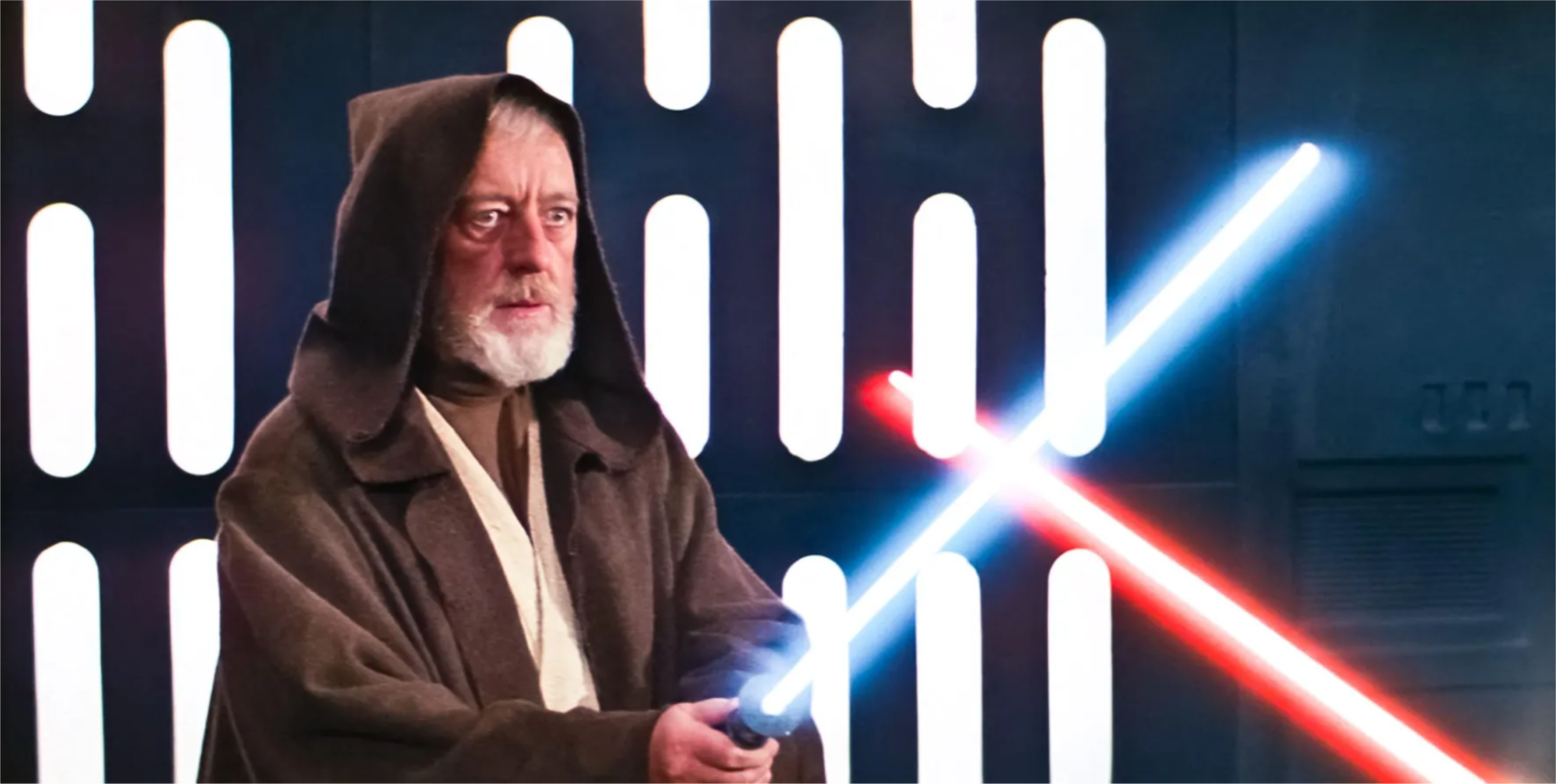
Alec Guinness in Star Wars: Episode IV — A New Hope (1977) ALAMY
I’ve studied everything about Alec Guinness, down to the smallest details. He lived in two worlds: casual country life and polished London elegance —the haunts of ‘the actor knight’. I discovered the cologne he wore, Number 89 from Floris, a refined, enigmatic fragrance with floral rose notes. Anna Gilchrist, one of their bespoke perfumers, described it as “a cologne worn by a man who doesn’t want everything to be displayed at once”. I spray it as a final touch before going on stage, a very personal connection to him. There is pressure playing such a distinguished figure. But I sincerely hope that, if he were to walk into the theatre, he would feel it was a respectful, sensitive portrayal. I want to show that he still matters. Children today may never stumble across him the way I did, serendipitously, on television. That’s why this play is important — to remind people who he was, and why, 25 years since his death, he remains unforgettable.
Zeb Soanes stars in Two Halves of Guinness at the Park Theatre, London
April 20 to May 2, after a UK tour, twohalvesofguinness.com